ChatGPT Ads is coming to the Czech Republic. How does the new advertising system work, and what does it mean for digital marketing?
Search advertising has long been based on the principle whereby a user enters a query and the advertising system attempts to find offers that match their search intent. Generative AI is gradually changing this model. Users no longer need to translate their needs into a few keywords; instead, they can describe their problem, specify their requirements, budget or constraints, and, within a single conversation, gradually compare options until they reach a decision.
ChatGPT Ads is based precisely on this principle. Following several months of testing in the United States, OpenAI began rolling out the advertising service to other markets in 2026. In August, ChatGPT Ads were launched in 31 European countries, and the self-service Ads Manager has also been available in these countries since 31 August. The Czech Republic is among the supported countries, and campaigns can currently be created independently there.
ChatGPT dominates the AI chatbot market.

According to data from Statcounter, ChatGPT accounts for almost 80 per cent of web traffic in the AI chatbot category.
At TRITON IT, ChatGPT Ads are no longer just a topic we’re keeping an eye on. Following their launch on the Czech market, we’ve deployed them in live campaigns for our own marketing as well as for our client ARVAL, the market leader in operational leasing in the Czech Republic. It is precisely when setting up campaigns that it becomes clear this is not merely a new advertising format placed within the ChatGPT environment. More significantly, there is a change in how the advertising system assesses relevance. When selecting adverts, OpenAI takes into account conversational intent and the context of the current conversation. If a user has ad personalisation enabled, selected signals from their broader use of ChatGPT may also influence the selection. The advertising system thus obtains a different type of information compared to traditional search, where the main input is a specific search query.
How ChatGPT Ads work
Advertisements appear below ChatGPT’s responses and are clearly separated from them. An ad unit contains the advertiser’s name, logo or favicon, headline, description, landing page and, depending on the specific format, visual creative. The advert is not part of the response generated by the model and, according to OpenAI’s rules, must not influence its content. The advertiser is therefore not buying the opportunity for ChatGPT to recommend their product; they are purchasing advertising space within an environment where the user is addressing a specific problem or making a decision.
 What is particularly interesting about ChatGPT Ads is what the system considers to be context. The advertiser does not work with just a few keywords, but can describe the situations and needs in which their product is relevant. For example, if we sell running shoes, we can guide the system to situations like a beginner preparing for his first race, not just the words ‘running shoes’. However, the context clue itself is not precise targeting or a guarantee of display.

The difference compared to traditional search advertising is most clearly seen in the way user intent is formed. A user searching, for example, for ‘a laptop for up to 40,000 Kč’ provides a conventional advertising system, such as Google Ads, with relatively limited information. In ChatGPT, however, they can specify within a few messages that they need the laptop for graphics work, will be carrying it around frequently, do not want macOS, require a certain level of battery life and, at the same time, do not want to exceed a set budget. From an advertising perspective, this generates not just a single query, but a context that makes it possible to determine more precisely what type of offer might be relevant.
This principle does not mean that ChatGPT Ads rely solely on loose semantic evaluation. Within ad campaigns, advertisers can use ‘context hints’. These are used to describe the topics, situations and needs in which the advert should be relevant. These are not traditional exact-match keywords, and the inclusion of a specific phrase does not in itself guarantee that the advert will be displayed. The outcome is determined by the overall relevance of the offer to the given context.
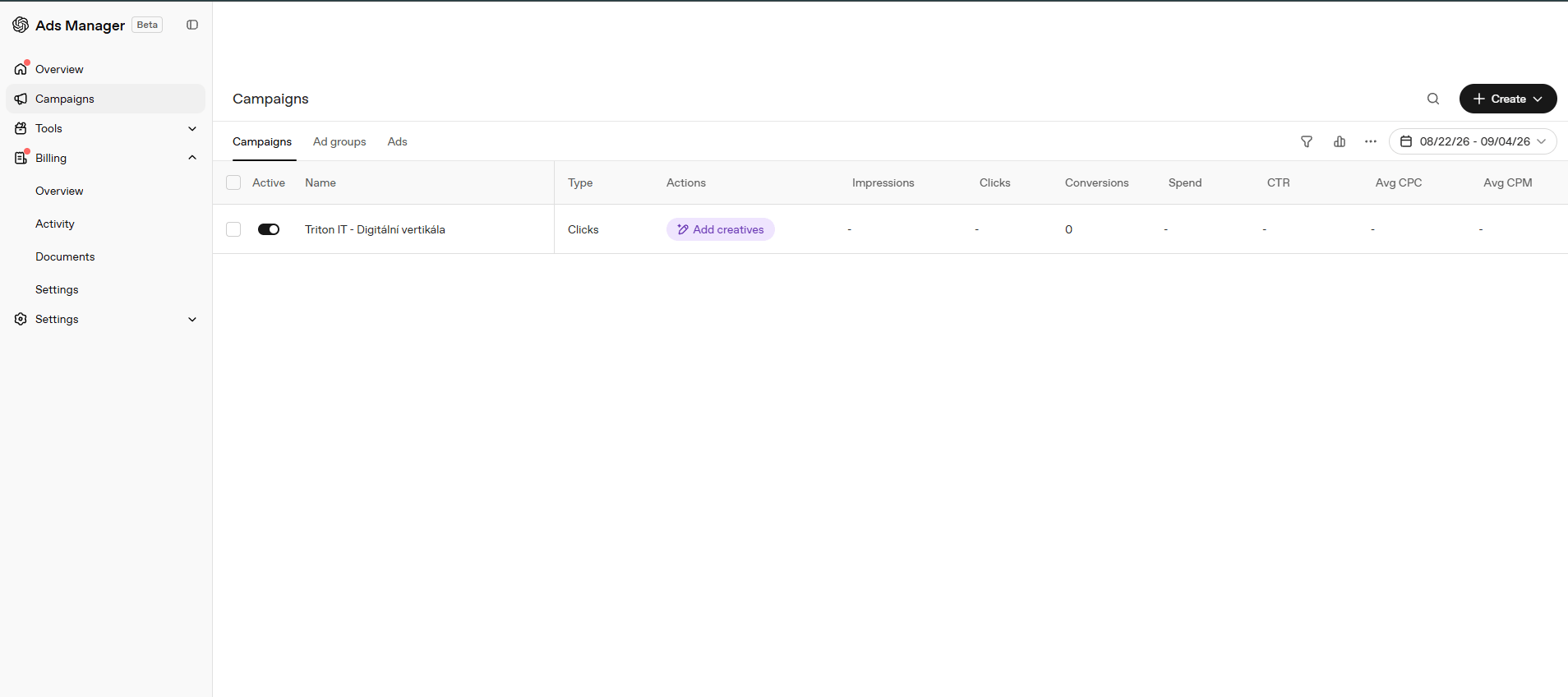
From a practical point of view, this creates a difference between the two approaches. With Google Ads, it is natural to start by asking which search queries we want our ad to appear for. With ChatGPT Ads, it is more appropriate to first identify the customer scenarios in which the product or service is relevant. A seller of office chairs therefore needs to consider not only users searching for an ‘ergonomic chair’, but also people who are dealing with prolonged periods of sitting at a computer, setting up a home office or furnishing a new workplace.
Privacy and personalisation
The context used by the advertising system to select adverts should not be confused with the advertiser’s access to conversations. OpenAI states in its official documentation that advertisers do not have access to users’ private conversations. Where ad personalisation is enabled, the system may utilise selected signals from users’ broader use of ChatGPT, but this information is not passed on to the advertiser in the form of specific conversation histories.
Furthermore, adverts are not shown to all users. OpenAI’s current rules state that they apply to the Free and Go plans. Users on the Plus, Pro, Business, Enterprise and Edu plans do not see adverts, and adverts are not supposed to be shown to accounts identified as belonging to people under the age of 18.
How to set up campaigns in ChatGPT Ads
From a campaign perspective, ChatGPT Ads is already a fairly standard performance-based advertising system. In Ads Manager, you first create a campaign, which defines the basic settings, in particular the business objective, budget, time period and geographical targeting. The platform supports campaigns focused on reach, clicks and conversions, and allows you to work with CPM, CPC and conversion-based optimisation. Geographical targeting is currently based on countries; it is also possible to target specific platforms separately, such as websites, iOS or Android. Payment options are the same as for standard PPC campaigns.
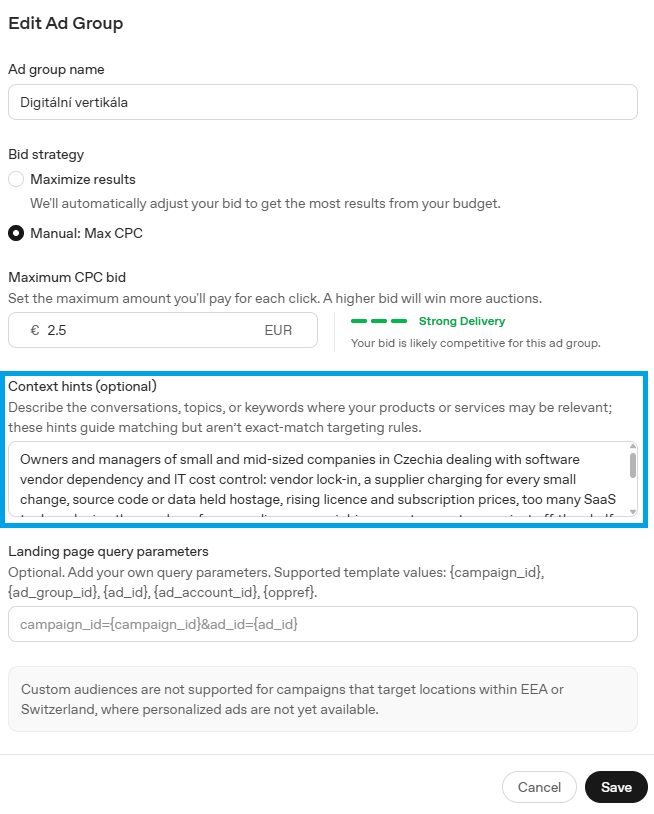
The campaign is organised into ad groups. It makes sense to structure these ad groups according to the product range and customer scenarios, rather than solely based on the technical structure of the website. For example, an electronics e-shop could separate laptops for professional use, gaming devices and products for students. Each group can have its own context hints, adverts and, where appropriate, audience. This structure also makes it possible to evaluate separately which types of customer scenarios are delivering results.
In addition to context, custom audiences can also be utilised. An advertiser can upload their own database of customers or potential customers to Ads Manager and subsequently use that audience to include or exclude people from a campaign. The data may be based, for example, on email addresses, telephone numbers or Google Advertising IDs. For inclusion targeting and bid adjustments, at least 25,000 matched users are required; OpenAI recommends audiences of at least 100,000 users for these purposes. Smaller audiences can be used for exclusion.
From a performance marketing perspective, it is important that ChatGPT Ads is no longer just a model based on buying impressions or clicks. The platform also allows you to optimize for subsequent conversion, so we can track whether the user actually did what we need from the campaign after clicking. This is the difference between testing a new ad format and a real performance channel.
Custom audiences are not a tool for selecting specific individuals. Ads Manager works with audiences as a whole. At ad group level, you can also set a bid multiplier between 0.1× and 10×, which increases or decreases the maximum bid when a user matches the selected audience. If a user matches multiple audiences with different multipliers, the highest applicable value will be used.
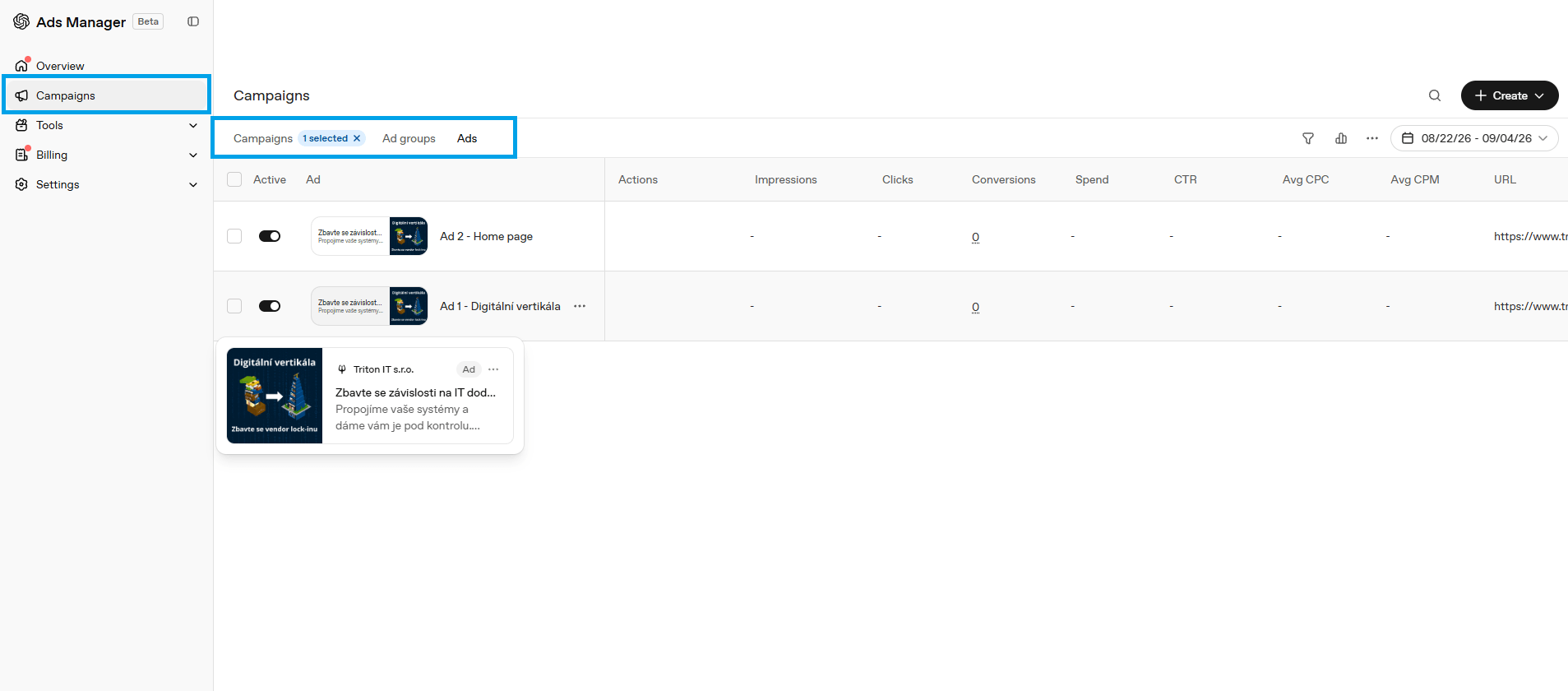
It is advisable to prepare a large number of variations of the adverts themselves. OpenAI recommends combining different headlines and descriptions, and basing each variation on distinct arguments, rather than simply rewriting the same wording mechanically. The reason for this lies in how the system works: an advert should be relevant to the various contexts in which the same offer might be needed. OpenAI also states that clear, specific and benefit-focused messages are more likely to be assessed as relevant.
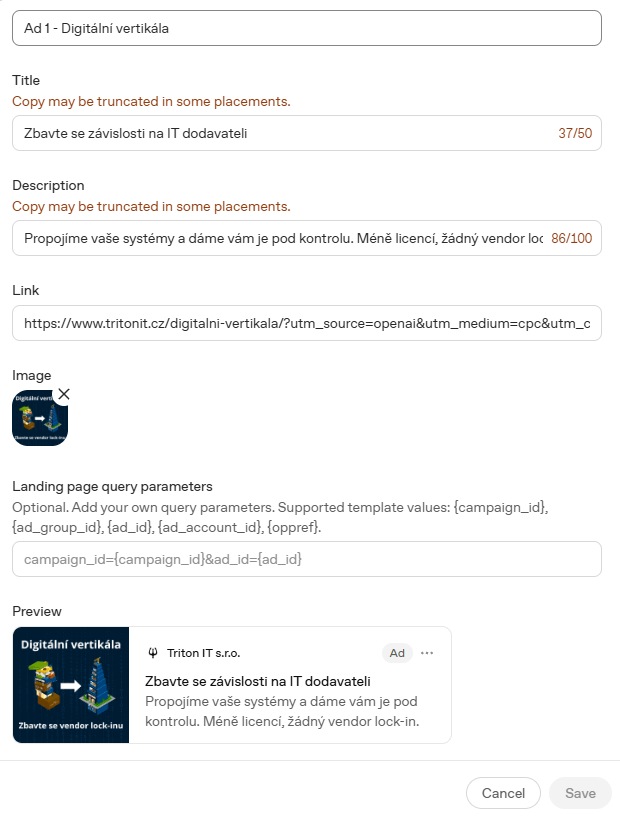
From a strategic perspective, it is therefore important to distinguish between targeting and ad content. Context hints help the system determine in which situations an offer may be relevant, whilst the creative itself must clearly explain to the user why the offer is of interest in that particular situation. It is therefore not advisable to simply transfer an existing set of adverts from Google Ads to ChatGPT Ads and expect the same result.
Bids, auctions and conversion optimisation
ChatGPT Ads support ad buying via CPM and CPC. CPM campaigns are optimised for impressions and are billed per thousand impressions, whilst CPC campaigns aim to generate clicks. In addition, OpenAI has gradually expanded the system to include conversion optimisation, i.e. optimising delivery based on conversion actions. This shifts the advertising platform away from simply buying traffic towards a model that seeks out users who are more likely to achieve the desired outcome.
What are CPC and CPM?

CPC (Cost per Click) refers to the cost per click on an advert; the advertiser therefore pays based on how many users actually click on the advert. CPM (Cost per Mille), on the other hand, refers to the cost per thousand ad impressions, so the advertiser pays for the ad to be served to users regardless of whether anyone clicks on it. CPC is therefore typically used for campaigns focused on website traffic or user engagement, whilst CPM makes more sense where the main objective is to reach as many people as possible and increase brand awareness.
OpenAI states that the auction uses a relevance-weighted second-price auction model. The bid amount is therefore not the only factor determining whether an advert is displayed. The relevance of the advert to the given context also plays a part in the outcome. This is an important distinction from the simplified view of an advertising auction as a competition for the highest cost per click.
For practical evaluation, it is therefore necessary to monitor not only impressions and click metrics, but above all the financial outcome. Ads Manager allows you to track, for example, impressions, clicks, CTR, CPC, CPM, spend and conversions. To measure conversions, you can use the OpenAI Pixel and the Conversions API, and traffic can be tagged with UTM parameters as standard for subsequent analysis in analytics systems.
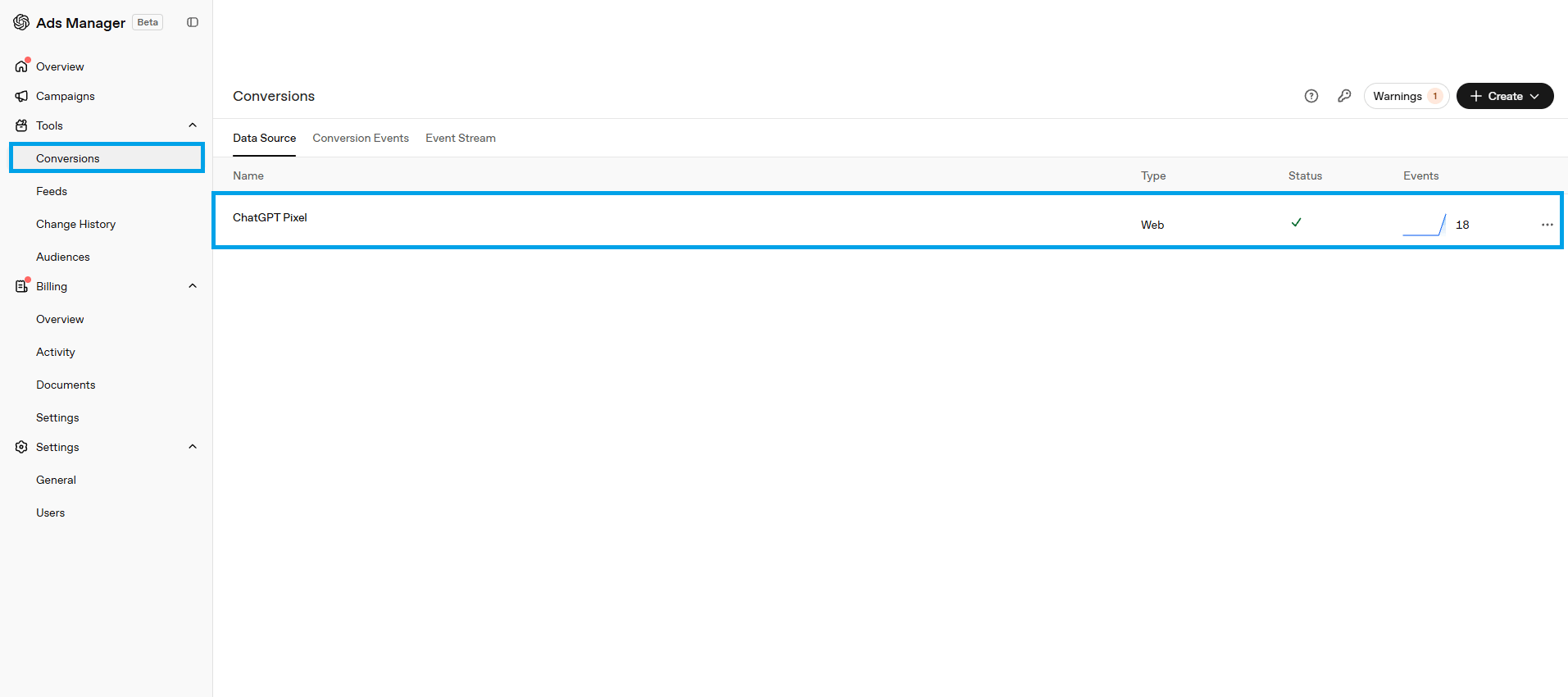
Product feeds and e-commerce
Product feeds offer a unique opportunity for online shops. Instead of manually creating adverts for individual products, a catalogue containing structured product data can be uploaded to the system. OpenAI supports, for example, product names, images, prices, promotional prices, brands, ratings and other details. The feed can be supplied as a CSV or TXT file, via a hosted HTTPS address or via SFTP, which also allows for automated updates.
An automated feed is particularly important for larger catalogues, where prices, availability and product ranges change too frequently for it to be efficient to manage individual products manually. At the same time, it is important to distinguish between the advertising and organic use of product data. Including a product in an advertising feed does not mean that the product will automatically start appearing in ChatGPT’s organic results.
The adoption of LLMs is changing the way people use traditional search engines.

A study entitled ‘The Impact of LLM Adoption on Online User Behaviour’, by Nicolas Padilla, H. Tai Lama, Anja Lambrecht and Brett Hollenbeck, analysed data on user behaviour when searching for information. The authors found that, following the adoption of LLM tools, user activity on traditional search engines fell by between 20 and 33 per cent.
Who would benefit from ChatGPT Ads?
The most promising potential lies in products and services where customers compare multiple factors before making a purchase, and their decision-making process is gradual. Typically, these include e-commerce sites with a more comprehensive range of products, software, travel, cars, education, technology products or B2B services. In these categories, it is common for customers to first need to define their requirements, compare options and only then select a specific offer.
Conversely, there is no reason to expect that ChatGPT Ads will automatically be more effective for every product. For low-margin goods, very small target audiences or products with a minimal decision-making phase, traditional search or social media may perform better. Decisions must therefore be based on real data, rather than on the general assumption that a new channel will automatically be cheaper or more effective.
The first test should have a clearly defined objective, appropriate metrics and an evaluation that is separate from other advertising channels. In e-commerce, it is advisable to start with products for which a product feed can be easily managed and whose profit margins allow for a testing budget. In B2B, it is more important to precisely define customer scenarios and conversion events, as the number of conversions tends to be lower and a single click is less indicative of success.
ChatGPT Ads are shifting advertising from search queries to context
The most significant change brought about by ChatGPT Ads lies in how they handle user intent. Traditional search advertising is based primarily on what the user has entered into the search engine. ChatGPT Ads can analyse the broader context of a conversation and use this to determine whether a particular offer is relevant.
For marketers, this means they need to think not only in terms of keywords and audiences, but also in terms of customer situations and decision-making processes. The technical implementation is already relatively well defined: there is Ads Manager, various campaign objectives, CPM, CPC, conversion optimisation, geographical targeting, context hints, custom audiences, product feeds and measurement tools.
Czech companies will therefore have the opportunity to put this new channel through its paces from September 2026. At the same time, however, there is no reason to overestimate its current volume. Traditional search remains a significantly larger source of traffic, and ChatGPT Ads do not yet have a sufficient track record to allow us to say with any certainty in which segments they will outperform established advertising platforms in the long term.
I wouldn't argue with ChatGPT Ads as a replacement for Google Ads. With Google, a user usually formulates a specific query and the ad responds to it. In ChatGPT, intent is created gradually throughout the conversation - the user can describe their problem, requirements, budget, and what they have already tried. For some products and services, the context of the decision may be more interesting than one specific keyword.
The relevant question, therefore, is not whether ChatGPT Ads will replace Google Ads, where changes have recently been made to the bidding system. What matters is to determine which types of customer intent the conversational advertising system can capture better than traditional advertising channels, and whether this relevance can be translated into measurable business results.
We are already actively using ChatGPT Ads here at TRITON IT. Once it became available on the Czech market, we explored the campaign settings, targeting options, optimisation and measurement, and subsequently put this new advertising channel into practice. Campaigns are now running both for our internal marketing purposes and for our client ARVAL, the market leader in operational leasing in the Czech Republic. So we’re not just gathering information on how the platform works based on OpenAI’s documentation – we already have our own campaigns and data, which we can use to evaluate its behaviour and results.
 Given that at TRITON IT we have been working with both performance marketing and focusing in depth on IT and technology for a long time, we immediately used the possibilities of the new channel both for our advertising purposes and to supplement our clients' campaigns.

A Comparison of ChatGPT Ads and Google Ads
| Google Ads | ChatGPT Ads |
|---|---|
| It primarily works with a search query | It takes the context of the conversation into account |
| The user enters keywords | The user describes the requirement in natural language |
| The auction is in response to a specific enquiry | The auction system takes context and relevance into account |
| The result is a results page | The advert appears directly within the chat interface |
| Users often compare information across several websites | Users can carry out a large part of the decision-making process within a single conversation |
| Keywords and search intent play a significant role | Conversational intent plays a significant role |
FAQs about ChatGPT Ads
What are ChatGPT Ads?
ChatGPT Ads is OpenAI’s advertising system, which enables paid adverts to be displayed directly within ChatGPT. The adverts are displayed separately from ChatGPT’s responses, and their selection is based, amongst other things, on the context and intent of the current conversation.
Who can see ChatGPT Ads?
Adverts are shown to users on the Free and Go plans. The paid plans – Plus, Pro, Business, Enterprise and Edu – remain ad-free; adverts are also not shown to accounts held by users under the age of 18.
How do ChatGPT Ads differ from Google Ads?
Google Ads primarily respond to a user’s specific search query. ChatGPT Ads can take into account the broader context of a conversation – not just what the user is searching for, but also the problem they are trying to solve, their needs or the stage of their decision-making process.
How much does advertising on ChatGPT cost?
There is no fixed price. Campaigns can, for example, operate on a CPC basis, where the advertiser pays per click, or on a CPM basis, where they pay per thousand impressions; for conversion-focused campaigns, optimisation for a specific action can also be utilised. The final price depends on the auction, competition and the relevance of the advert.
Is it worth running ChatGPT Ads for my business?
They have the greatest potential where customers are facing more complex decisions before making a purchase or are looking for a specific solution to a problem.
Do you want to be seen in ChatGPT?
Related articles
 About us
How is artificial intelligence used in video production? What are MCP servers and how do they help developers? And what if you could control...
 Content
ACOND is one of the leading Czech manufacturers of heat pumps and has been operating on the market since 1998. The development, testing and...
 Advices and tips
From 17 August 2026, Google is changing the way certain automated bidding strategies work for campaigns with limited budgets. The change affects...