Marketing Radar #1: Google is changing the rules for PPC advertising, Meta is restricting control over ad placement, and Google is expanding AI Max
The automation of advertising platforms is extending into further areas that advertisers previously controlled themselves. Google Ads has stopped using manual language targeting in search campaigns; some advertisers on Facebook and Instagram are losing the ability to exclude specific ad placements; and Google is simultaneously automatically converting selected search campaigns to AI Max. The next phase of the migration to dynamic ads is scheduled for February 2027.
At first glance, these appear to be three separate product changes. In reality, however, they point in the same direction: advertising systems are taking on an ever-greater share of the decision-making regarding who to show an advert to, for which search query to serve it, what format to present it in, and where to deliver it. Advertisers are left with budgets, business objectives, creative assets, data and some options for limiting automation. Their role is therefore shifting from manually setting individual parameters to managing the entire system and continuously monitoring its results.
For businesses, this is no reason to automatically disable new features or accept all platform recommendations without question. It is a reason to review campaign settings, the quality of measurement, and whether automation is actually optimising the results that matter to the business. Let’s look at all three changes in detail, including who they will affect most and what advertisers should do.
In the ‘Marketing Radar’ series, we will be tracking changes to digital platforms, explaining how they work and focusing on what they actually mean for marketing practice.
1. Google Ads is phasing out manual language targeting in search campaigns
From October 2026, campaign language settings can no longer be used as an active targeting condition in standard Google Ads search campaigns. The same change applies to AI Max for Search and adverts displayed on Google Search as part of Performance Max. In other Performance Max channels, such as YouTube, the Display Network, Discover and Gmail, language settings will continue to function as before.
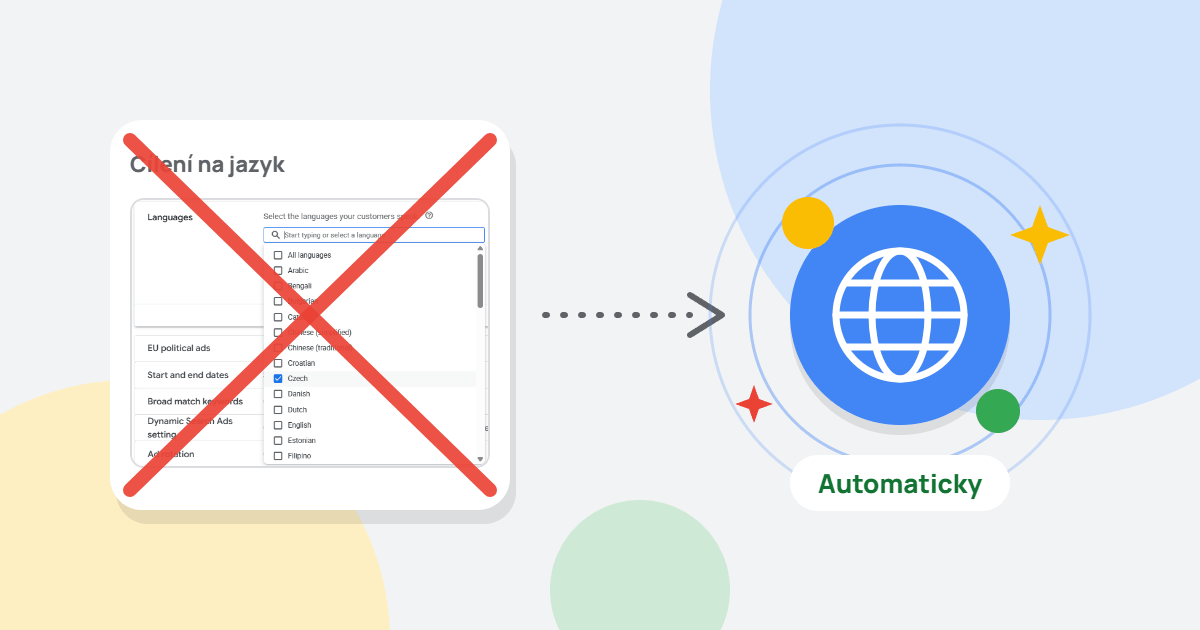
The originally planned deadline of the end of 2025 has been pushed back by approximately ten months. It is not simply a matter of removing a single option from the settings. The way in which the system determines which language version of an advert is most suitable for a particular search is changing.
How Google now determines the language of an advert
Until now, an advertiser could, for example, set up a Czech search campaign to target users with a specific language setting. Google now automatically assesses language relevance in search results. It takes into account the language of the ad creative, the landing page, the search query and the user’s language preferences. These need not necessarily correspond solely to the language set on the user’s phone or in their browser: Google also takes into account the languages the user regularly works with or uses when searching.
If an account has several relevant campaigns or ad groups in different languages, the system attempts to prioritise the variant that best matches the search language.
Let’s imagine a Czech online shop that also sells in Slovakia. The Czech and Slovak campaigns may respond to a similar search query, even though each uses different ad copy and different prices. It will now be even more important for Google to correctly identify, based on the ad content and landing page, which variant is suitable for the user. Simply labelling a campaign as Czech or Slovak no longer restricts language targeting in Search.
However, this does not mean that Google will automatically translate every advert or that it will no longer be possible to run separate language campaigns. The change primarily concerns the way in which adverts are selected, not an obligation to merge campaigns into a single structure.
What the change means for targeting overseas markets
Advertisers who operate across multiple countries, use different language versions or target specific foreign-language audiences should pay particular attention to this change.
A company operating in the Czech Republic may, for example, target foreign workers, students or tourists. If it wishes to reach an English-speaking audience, it needs appropriate English-language adverts and a landing page. Manually setting the language alone is not enough to restrict delivery to the desired group.
A similar situation arises for companies expanding abroad. Advertising in English may not be sufficient for the local market, even in a country where some of the population speaks English. The localisation of adverts, offers, currencies, terms and conditions, and landing pages remains an important part of the campaign. Automatic ad selection is no substitute for market knowledge.
Geographical targeting remains fully available. If a company needs to distinguish the Czech Republic from Slovakia, Poland or another market, it must continue to set the geographical restrictions correctly. Language and country are two different things: a user in the Czech Republic may search in English, whilst a user in Slovakia may use Czech.
Accounts in which the languages of the adverts and landing pages are mixed are particularly risky. A Czech advert leading to an English page sends less clear signals to the system than when both the advert text and the landing page are in the same language.
Which campaigns and reports to check
Following the change, we recommend that you review, in particular, accounts with multiple language versions to check whether delivery has shifted away from the originally intended audience. The first step is to regularly check the search query overview, where you can identify any unwanted linguistic or thematic deviations.
It is also important to compare the performance of individual markets, rather than just the overall results for the entire account. Monitor the cost per conversion, conversion rate and impression share, and evaluate the results in conjunction with the campaign language and geographical targeting.
A change in delivery may affect the cost per click, click-through rate and conversion rate. If any of these metrics change after September 2026, it is incorrect to automatically attribute the cause to language targeting. It is also necessary to take into account budgets, seasonality, the competitive environment and other changes to campaigns.
Single-language accounts that advertise in only one language in a single market and have corresponding landing pages are likely to experience a lesser impact. For these, it is usually sufficient to check that no new, irrelevant opportunities are appearing in search queries.
What we recommend you do
The most important thing is to maintain a clear structure for campaigns by market, check geographical targeting and ensure that ad copy and landing pages are tailored to the intended audience. The language settings in search campaigns no longer serve the same purpose as they used to.
Furthermore, companies that manage campaigns via the Google Ads API or their own automation scripts should check that their tools are no longer creating or modifying language criteria for Search. Google advises that the new requirements for adding or updating language criteria in Search campaigns are no longer permitted.
The practical conclusion is simple: the language used in adverts and on landing pages is now a more important part of campaign management, whilst the markets department must continue to focus primarily on ensuring the account is structured correctly and that geographical targeting is in place.
2. Meta Ads restricts the ability to disable ad placements
Another significant change concerns adverts on Facebook and Instagram. Since August 2026, some advertisers have begun receiving notifications in Meta Ads Manager that the option to exclude specific placements, platforms, devices and operating systems at ad set level will be removed. The change is being rolled out gradually, and not all accounts have the same options. As of 20 October 2026, there is no confirmed uniform deadline by which the change is due to be fully implemented.

It is important to distinguish between information about a change to the interface and an officially confirmed specification. The change was noted by advertisers and reported by specialist media; however, according to the information available, Meta has not issued a separate public announcement that would clearly set out the scope and timetable for all accounts. It is therefore necessary to check the specific options directly within the relevant advertising account.
What exactly is changing in the ad settings?
Previously, when using manual placements, an advertiser could choose to run an advert, for example, only in the Instagram Feed, but not in Reels, Messenger or the Audience Network. Under the new model, this option at ad set level is being phased out in the accounts concerned.
The restrictions do not apply solely to individual placements. They also include the option to exclude an entire platform, limit delivery to a specific type of device, or select a particular mobile operating system. This is important, for example, when promoting an app available only on iOS or for campaigns where the conversion process is designed primarily for desktop.
Meta is thereby strengthening its automated decision-making process regarding where adverts are displayed. The choice of placement is important not only in terms of price, but also in terms of the quality of traffic, the suitability of the format, and the environment in which the brand is presented.
Value rules are not the same as disqualification
Value rules are used as a fallback mechanism. These allow the bid to be adjusted according to selected characteristics, such as location or device. According to available descriptions, the range of bid adjustments extends up to +1,000 per cent and down to a maximum of -90 per cent. The rules have a limited number of conditions and do not cover all combinations of platforms and locations.
The difference is fundamental. Excluding a placement tells the system not to display an advert there. A value-based rule merely changes the economic priority of that placement. Reducing the bid by 90 per cent is therefore not the same as a complete ban on delivery.
If, for example, a company has long excluded certain locations due to poor-quality enquiries, simply reducing the number of adverts may not solve the problem. The advert may still be displayed in those locations if the system deems the auction to be profitable.
Certain options for strict restrictions, however, remain at the level of the entire advertising account. For selected placements, account settings that apply to multiple campaigns can be utilised. However, such restrictions are not a suitable substitute for individual settings: if a company wishes to exclude a placement from just one campaign whilst continuing to use it elsewhere, it needs to follow a different procedure.
Why a change might reduce the quality of enquiries
The impact will vary significantly depending on which outcome the campaign is optimising for and how well the system recognises the value of an actual conversion.
For an online shop with sufficient sales volume and high-quality tracking, wider availability of advertising space can bring further opportunities. The algorithm can seek out cheaper ways to acquire customers without the advertiser having to focus on manually selecting each placement.
The situation is more complex for campaigns aimed at generating enquiries. A low cost per form submission does not necessarily mean that the company has acquired a valuable customer. If some of the ad placements generate more accidental clicks or low-quality forms, the cost per lead may appear to improve, whilst business results deteriorate.
Let’s imagine a company offering leasing, financial services or technical solutions for businesses. Its aim is not to generate as many leads as possible, but to reach people who genuinely match the target profile and are interested in what it has to offer. If the system is optimised solely on the basis of submitted forms, it may fail to distinguish between high-quality and low-quality leads at all.
This is precisely where the importance of integrating advertising systems with CRM and sales data becomes apparent. If a company is able to assess which contacts have become qualified leads or customers, it can feed this information back into the advertising system, for example via the Conversions API. Optimisation can thus be based on results that are more commercially significant than simply the submission of a form.
Creative content must work across all locations
As the scope for manually selecting ad placements is reduced, the importance of ad creatives is growing. Creative designed for just one specific format may not work well everywhere it is displayed.
Vertical videos for Stories and Reels have different aspect ratios and requirements to feed ads. Important text may end up outside the safe area when automatically cropped, whilst a banner designed for a larger area may become illegible in a smaller format.
For most campaigns, it therefore makes sense to prepare a set of assets for the main formats: vertical 9:16, portrait 4:5 and square 1:1. For videos, it is advisable to include subtitles and a message that works even without sound. This is because automatic placement does not mean that every ad asset will automatically adapt to ensure it is optimal in every context.
How to assess change in practice
The first step is to check whether the new restriction has actually been applied to a specific account. We then recommend checking the current placement restrictions, account-level settings and value rules.
When evaluating campaigns, it is essential to analyse the breakdown of results by placement. The total cost per result may mask the fact that part of the budget is generating cheap but low-value visits. For lead generation campaigns, it is advisable to supplement advertising metrics with lead quality, sales opportunities and actual revenue.
At the same time, it is wrong to assume that every cheaper placement is automatically of poor quality. The key factors are the data for the specific campaign, the target audience and the definition of the business outcome.
Recommendations for businesses: check the options available in your advertising account, prepare creative assets for multiple formats, and evaluate campaigns based on the quality of the results, not just on the cost per click or per form submission.
3. Google Ads automatically converts selected campaigns to AI Max
At the same time, Google is changing the way search campaigns work through AI Max for Search. This is not an entirely new type of campaign, but a set of features that enable the system to expand the reach of adverts, edit ad copy and select suitable landing pages.
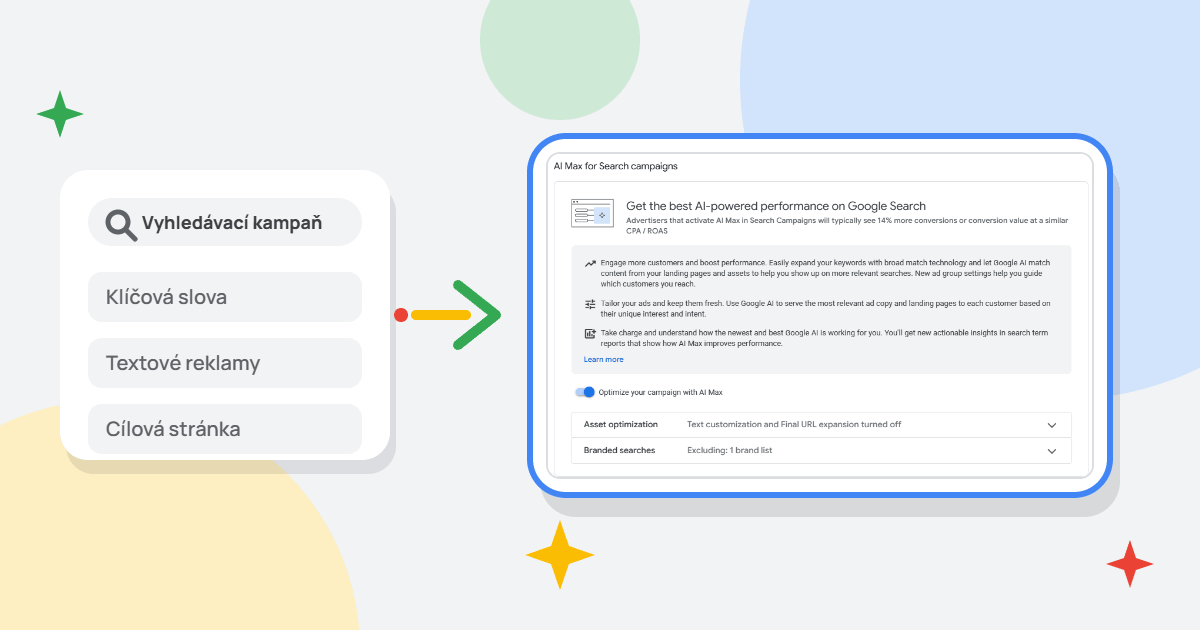
In September 2026, Google began automatically migrating selected search campaigns that used broad match settings at campaign level or separate Automatically Created Assets (ACA). The migration took place between 1 and 30 September. Older Dynamic Search Ads (DSA) have their own timetable: automatic migration is scheduled for February 2027.
This change is particularly important because it broadens the scope within which Google can make decisions without direct instructions from the advertiser. Keywords no longer need to be the sole determinant of ad delivery; the ad copy can be tailored to a specific search, and the visitor may end up on a different page from the one the advertiser originally selected.
What features does AI Max include?
AI Max combines three main functions. Each one affects a different part of the advertising process, and each requires its own set of controls.
The first feature is ‘Search term matching’, i.e. the expansion of search queries. The system can also display adverts for searches that do not directly match the set keywords, provided it assesses that they are relevant to the user’s intent. This can help identify new relevant opportunities, but at the same time may also attract traffic that is not relevant to the company’s offering.
The second feature is ‘Text customisation’, previously known as ‘automatically generated ad copy’. Google can create or edit headlines and descriptions based on the website’s content, existing adverts and the search context. As a result, the final advert may not be identical to the text prepared and approved by the copywriter.
The third feature is Final URL expansion. Instead of a fixed landing page, the system can select another relevant page on the website. For example, if it determines that a product category is a better match for a particular query than the page originally set, it can redirect the visitor there instead.
According to Google’s documentation, these features can be controlled separately within the relevant settings: query expansion at report level, text modification and target URL expansion at campaign level. URL expansion is, however, linked to text modification being enabled.
What happens during automatic migration
Automatic migration does not mean that Google will create a completely new account or discard the campaign history. According to the published information, eligible campaigns are migrated in situ, whilst retaining their IDs and existing history. The settings are converted to the corresponding AI Max configuration.
For campaigns using automatically generated ad groups, query expansion and text editing are enabled by default. For campaigns with broad match at campaign level, query expansion is enabled. For older DSA campaigns, migration to standard search campaign structures with AI Max is scheduled to take place in February 2027.
For advertisers, this means that it is not enough simply to check whether a campaign is active and whether its budget has changed. It is also necessary to verify the features used following the migration and their impact on ad delivery.
Particular attention should be paid to businesses that use dynamic ads to cover extensive websites, such as online shops, travel agencies or product and service catalogues. For these projects, choosing the right landing page is crucial for both conversion rates and measurement.
Why it is not enough to rely on automated texts
The automatic generation of advertising copy can be useful where there is a need to cover a wide range of queries and products. At the same time, however, it carries the risk that the resulting text will not accurately reflect the offer, current terms and conditions, or the brand’s communication style.
If a website contains outdated information, prices that are no longer current or promotions that have already ended, the system may be working with inaccurate data. In regulated sectors, such as finance, insurance, leasing or healthcare, it is also important to check the accuracy and permissibility of advertising claims.
Google offers tools for brand management, URL exclusion, text-based instructions and limiting unwanted generated content. Text-based rules can be used to specify prohibited terms or additional instructions to the system. However, these measures are no substitute for checking the adverts that are actually displayed.
A similar approach is required when expanding target URLs. If a company invests in a dedicated landing page created for a specific campaign or is testing two versions of a website, the automatic selection of a different page may alter the conditions of the experiment. A visitor may be directed to a blog, a category page or an information page which, whilst thematically relevant to the search query, is not designed to fulfil the same conversion goal.
In such cases, it makes sense to disable URL expansion or exclude specific pages. The aim is not to restrict automation across the board, but to allow it to operate where it has sufficiently high-quality input data and where its decision-making does not jeopardise the campaign’s business objectives.
Keywords do not lose their significance; rather, their role changes
One common misconception is the idea that AI Max spells the end of keywords. It would be more accurate to say that keywords are no longer the sole mechanism that determines which search queries an advert may appear for.
This highlights the importance of negative keywords. If the system expands reach based on the user’s estimated intent, the advertiser needs an effective way to filter out queries that are unsuitable for their offer. In some accounts, reach expansion may bring in new customers, but in others it may use up the budget on traffic with low commercial value.
It is also crucial to set up conversion tracking correctly. Bid and targeting automation works with the information available to it. If the system only receives a signal about a visit or a submitted form, it may not be able to distinguish between a genuinely valuable customer and a low-quality lead. The quality of the data therefore directly influences how useful the results of the automation will be.
New reporting features help reveal what AI is actually doing
As part of the roll-out of AI Max, Google is also introducing more detailed reporting. In September 2026, it began making the AI Max Search Journey report available, which links the search query, the ad copy used and the landing page. In the search query reports, it is also possible to distinguish between traffic generated via keywords and traffic generated by the AI Max extension. The landing page report allows you to check the actual URL used.
This is an important development for specialists. It is not enough simply to monitor the cost per conversion at campaign level. They need to find out what new search queries the system is handling, what ad copy it is generating, and which pages it is sending visitors to.
Similarly, it is essential to evaluate pre- and post-migration results carefully. A campaign may still have the same ID, but its behaviour will change. A direct comparison of performance without taking the new configuration into account may therefore lead to erroneous conclusions.
Companies that export data to Looker, BI tools or their own reporting tools should check whether the new dimensions and reports meet their needs and whether their existing data connections are still working correctly.
What we recommend doing before February 2027
Businesses using dynamic search ads should not wait for the automatic migration. It is advisable to first check the existing campaign structure, negative keywords, target URL rules and conversion tracking methods. They can then test AI Max on a carefully selected portion of their budget and compare its results with their current approach.
For campaigns where the exact wording of the adverts is crucial, it is necessary to decide whether editing the text provides sufficient value, or whether it is more appropriate to keep the approved text under stricter control. For campaigns with important landing pages, it is advisable to test URL expansion and, where necessary, define excluded pages.
AI Max is not automatically a better or worse option than the original settings. It is a different way of managing a campaign, which can open up new opportunities but may also extend the reach beyond the original intention. The outcome depends on the quality of the website, measurement, ad creatives, conversion data and regular monitoring.
What do all three changes have in common?
Both Google and Meta are gradually shifting some of the decision-making from advertisers to their own algorithms. Google automatically analyses the language of an advert, expands search queries and may select different ad copy or landing pages. For the accounts concerned, Meta is restricting manual placement selection and steering advertisers towards automated delivery and bid adjustments.
This does not mean that manual adjustments are no longer important. It means that some of the tools used to date are becoming less effective and are being replaced by other mechanisms. Campaign managers must focus more on data quality, business objectives, supporting data and monitoring results.
These changes give rise to three practical priorities:
- Check the actual delivery, not just the settings. What is selected in the account may not correspond exactly to what the advertising system ultimately displays. Reports on queries, placements, landing URLs and conversions are important.
- Provide platforms with high-quality data. If an advertising system optimises solely for low-cost clicks or form submissions, it may achieve good advertising metrics without corresponding business results. Integration with CRM systems, the quality of conversion tracking and feedback on business outcomes are therefore becoming increasingly important.
- Manage automation, don’t just switch it on. AI can broaden your reach, save time and uncover new opportunities. However, without high-quality data, rules and ongoing evaluation, it can just as easily drain the budget on irrelevant traffic or create advertising messages that do not reflect the company’s offering.
In the long term, therefore, the value of a performance marketing specialist will not depend solely on their ability to configure individual campaign parameters. It will become increasingly important to be able to link advertising platforms to the company’s business objectives, ensure high-quality measurement, interpret data and decide where to allow automation to operate freely and where its scope needs to be restricted.
Do you want to optimize your existing campaigns?
Related articles
 Advices and tips
Search advertising has long been based on the principle whereby a user enters a query and the advertising system attempts to find offers that...
Advices and tips
From 17 August 2026, Google is changing the way certain automated bidding strategies work for campaigns with limited budgets. The change affects...
 About us
At TRITON IT, we are a partner of the Právě teď association, with whom we collaborated this year on the ‘March for the Brain’ event. The event,...