How we automate content creation at TRITON IT
Content marketing is undergoing one of the biggest changes of the last twenty years. Until recently, most companies focused primarily on traditional search engines, optimisation for Google and creating articles based on keywords. The way people search for information is now changing fundamentally. Large language models (LLMs) such as ChatGPT, Claude, Gemini and Perplexity are coming to the fore, and users are increasingly looking not for links to landing pages, but for direct answers to their questions.
Research shows that people are beginning to use LLMs as a new way of working with information, particularly when dealing with more complex queries, conducting research or comparing products. For example, the study *The Impact of LLM Adoption on Online User Behaviour*, published on SSRN, shows that following the adoption of LLM tools, there has been a decline of more than 20 per cent in traditional searches on platforms such as Google amongst some users. The research also confirms that users are combining traditional search with conversational AI systems and changing the way they consume content.
This has a significant impact on content creation. It is no longer enough to write content solely for search engine algorithms. Content must be structured, factually accurate, contextually rich and machine-readable, even for language models that subsequently use it to generate responses for their users. Content no longer competes solely for a position in search results, but also for whether it will be cited or utilised by AI systems themselves.
How we’ve approached content automation at TRITON IT
At TRITON IT, we have developed our own automated workflow for content creation. The aim was not to replace copywriters with artificial intelligence, but to create a system capable of significantly speeding up the production of high-quality content, ensuring consistency in the output, minimising errors and, at the same time, maintaining a high level of data security.
We build our workflow primarily on the n8n platform, which we run on our own servers. This is crucial for us. Many companies today are grappling with the question of whether their internal data ends up in anonymous repositories or is used for further model training. From the outset, we have opted for maximum control over both our data and our infrastructure. The workflow therefore runs entirely within our environment and enables us to securely integrate large language models, vector databases, multimedia repositories, online sources, communication tools and other internal client systems.

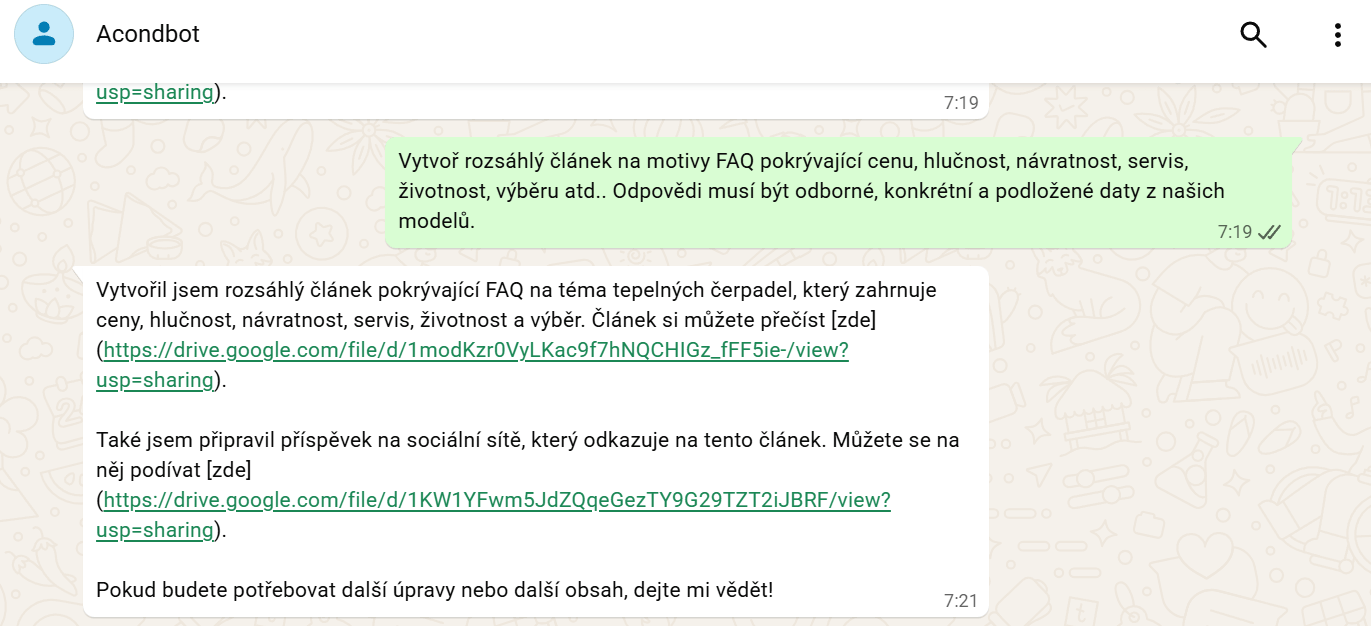
We have deliberately designed the workflow controls to be as simple as possible. Users can operate the entire system either via WhatsApp (using both standard text messages and voice messages) or via email, if required by the company’s internal security policies. From the user’s perspective, the whole process is extremely straightforward. For example, they might enter an instruction such as: “Create an article on topic X, focusing primarily on Y and Z; conclude with a comparison of products 1 and 2, and create five FAQs for undecided customers.” As soon as the request reaches the workflow, a highly complex set of processes is set in motion.
Knowledge base
At the heart of the entire system is the knowledge base. We create this individually for each client, as it is the quality of the context that determines the quality of the outputs. The knowledge base contains everything important that a company knows about its business – product sheets, catalogue documentation, manuals, internal know-how, the company wiki, contractual documentation, brochures, magazines, technical specifications and, for example, service documentation.
We then convert this data into a vector database. Vector databases are now one of the key building blocks of modern AI systems. Unlike traditional databases, they do not simply search for exact word matches, but work with semantic similarity. The information is converted into mathematical representations (embeddings), which enable the system to find semantically similar content even if the user uses a completely different phrasing for their query. For example, if a user requests an article on the efficiency of heat pumps in winter, the workflow does not need to search solely for the exact phrase ‘efficiency of heat pumps’. It can also find relevant documents on COP, energy efficiency, operating modes or heating optimisation, because it understands the semantic connection between these topics.
As soon as the workflow receives a request for a new article, it first begins to analyse the client’s knowledge base. It searches for relevant context, internal know-how, technical information and any supporting material that may enhance the informational value of the final text. Only if it cannot find certain information in the internal database does it turn to the internet. The workflow has precisely defined rules according to which it selects relevant sources, assesses their credibility and decides which ones to draw upon. This enables us to maintain a high standard of information whilst minimising the risk of hallucinations or poor-quality sources, which is one of the biggest problems facing generative AI today.
How does automated article generation work?
Once the workflow has sufficient information, it moves on to the actual content creation phase. This is where large language models come into play. In our case, the combination of ChatGPT and Claude has proven most effective over the long term. Each model has slightly different strengths, and it is precisely this combination that enables us to achieve better results than when using a single universal model.
However, the whole process is not based on a simple prompt such as ‘write an article’. We have defined dozens of rules and evaluation criteria within our workflow. We have precisely described the ideal outputs, as well as those that are unacceptable to us. We define the tone of voice, the structure of articles, text length, rules for citations and linking, the style of headings, how to handle FAQ sections, and the approach to different target audiences. Thanks to this, the workflow does not generate every piece of text in a completely different way. On the contrary. It is able to maintain a consistent communication style for a specific brand over the long term – a problem that many companies struggle with today when using AI.
Quality control system
Once the first draft of an article has been produced, one of the most important parts of the whole process begins – quality control. We have designed this as a multi-stage system of agents, with each agent handling a specific area of quality control.
The first stage focuses on factual accuracy. The agent goes through the entire article sentence by sentence, verifying individual claims against a knowledge base and public sources, and checking for any misinterpretations of data or inaccuracies. If they find a problem, they suggest specific amendments.
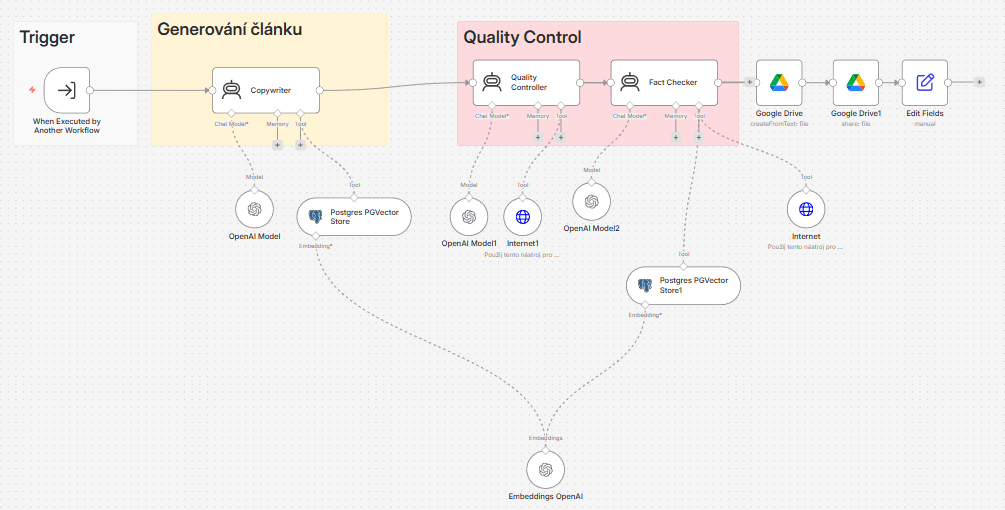
Only once an article has been verified as factually accurate does it move on to the next stage of review. A second agent analyses the text’s structure, tone of voice, readability, use of argumentation and compliance with all defined rules. Our workflow also incorporates our own assessment scales, which we use to measure the quality of the output. These scales are based on clearly defined ideal and non-compliant states, enabling us to assess with a fair degree of accuracy whether the text meets the required standard.
If the article does not pass, the workflow automatically suggests amendments and the whole process repeats. There may be several such iterations until the output meets all the requirements. Only then can the process continue.
Articles, press releases and social media posts
In the penultimate stage of the workflow, we incorporate another process – the creation of content for social media. For each article, a set of bespoke post templates is automatically generated for various platforms. Once again, this is done in accordance with pre-defined rules, tone of voice and the client’s target audiences. This is important not only to save time, but also to make the most of content that has already been created. A single high-quality article therefore does not end up solely on the blog, but is automatically repurposed for other communication channels.
The final distribution of the outputs then varies according to the client’s preferences. In some cases, the workflow saves the finished materials to a drive and sends links to the articles, saved in Markdown format, via WhatsApp or email. For other clients, the workflow communicates directly with the CMS and saves articles straight away as drafts ready for approval.
Why is content automation effective?
We have been using this entire system internally for over a year now and are gradually rolling it out to our clients as well. Recently, for example, we have implemented it for companies such as ACOND, Alutech Bohemia and Lázně Travel. We see the greatest benefits in three areas.
- A dramatic time-saver. The workflow eliminates a great deal of the repetitive work involved in content creation today, from research and sourcing materials right through to producing different versions of content for social media.
- Quality and consistency. Thanks to our knowledge base and multi-stage quality control, we are able to maintain significantly higher accuracy of information and a consistent style of communication.
- Security. For many companies today, it is unacceptable for internal documentation or know-how to end up on external cloud services without any control over the data. By running the workflow on our own infrastructure, we are able to offer clients a significantly higher level of control over both the data and the entire process.
Content marketing is becoming a technological discipline that brings together language models, data structures, automation, in-house expertise and well-designed workflows. Companies that recognise this shift in good time gain an advantage, not only in terms of faster content creation and lower costs per unit of output, but above all in terms of content quality, consistency and the ability to operate in an environment where an ever-increasing proportion of information is delivered via large language models.
Do you want to build a content creation automation system tailored to your needs?
Related articles
 About us
How is artificial intelligence used in video production? What are MCP servers and how do they help developers? And what if you could control...
 Content
ACOND is one of the leading Czech manufacturers of heat pumps and has been operating on the market since 1998. The development, testing and...
 Advices and tips
Search advertising has long been based on the principle whereby a user enters a query and the advertising system attempts to find offers that...