Google is changing how targeting strategies work in Google Ads. What does this change mean for campaigns with a limited budget?
From 17 August 2026, Google is changing the way certain automated bidding strategies work for campaigns with limited budgets. The change affects campaigns using Target CPA, Target ROAS and, in the case of Demand Gen, Target CPC. Campaigns that are unable to reach their full potential due to budget constraints should now work more consistently towards their set target.
At first glance, this may appear to be a technical change to Google Ads automation. In practice, however, it may affect the number of conversions, the cost per conversion and the way in which target values need to be set. It is important to note that Google does not automatically increase the campaign budget as a result of this change. For example, if a campaign has a daily budget of 1,000 Kč, this budget remains in place. What may change, however, is primarily how effectively this budget is utilised.
What does Google optimise?
When a user enters a search query into Google, a number of advertisers may bid to have their ad displayed. In each such situation, Google evaluates the auction and decides which adverts to display, in what order, and at what price. However, the final price for the advertiser is not simply determined by who offers the highest bid. Several factors are taken into account in the auction, including the bid, the quality of the advert and its expected performance.
Furthermore, with modern Google Ads campaigns, advertisers do not usually set bids manually for each individual search. Instead, they use ‘Smart Bidding’ – automated bidding strategies that aim to determine, in each auction, the appropriate bid amount based on the set objective. For example, an advertiser might tell Google that they want to secure orders at an average cost of 500 CZK. Google then uses the available data to decide in which auctions it makes sense to increase the bid and in which, conversely, to bid less.
What is Target ROAS?

Target ROAS (Return on Ad Spend) focuses on the value of a conversion rather than its cost. For example, an advertiser might set a Target ROAS of 500 per cent, which means they want to generate an average of five crowns’ worth of conversion value for every crown invested in advertising. Even in this case, it is not a fixed limit that applies to every auction or every order. It is a target towards which the automated strategy optimises its decision-making.
What does it mean for a campaign to be budget-constrained?
To understand the change in its entirety, the concept of ‘Limited by budget’ is key. A campaign finds itself in this situation when there are more opportunities to achieve further results than the current budget allows. In other words, the system could identify further relevant auctions and potentially generate additional conversions, but does not have sufficient funds available.
Let’s imagine, for example, an online shop with a daily campaign budget of 1,000 Kč. Throughout the day, there are plenty of relevant searches and auctions in which the advert could compete. If the system had 2,000 Kč at its disposal, it would probably be able to generate further visits and conversions. With a budget of 1,000 Kč, however, it has to be selective about the opportunities it pursues. It is precisely in this situation that the way Google handles its targeting strategy changes.
How campaign behaviour is changing as of 17 August 2026
In the case of a campaign with a limited budget, the system used to be able to operate relatively more freely within the set target. If a campaign was optimised for a Target CPA of 500 Kč, but the system was able to find enough cheaper conversions within the available budget, it could keep the resulting cost per conversion significantly below the set value.
Example:
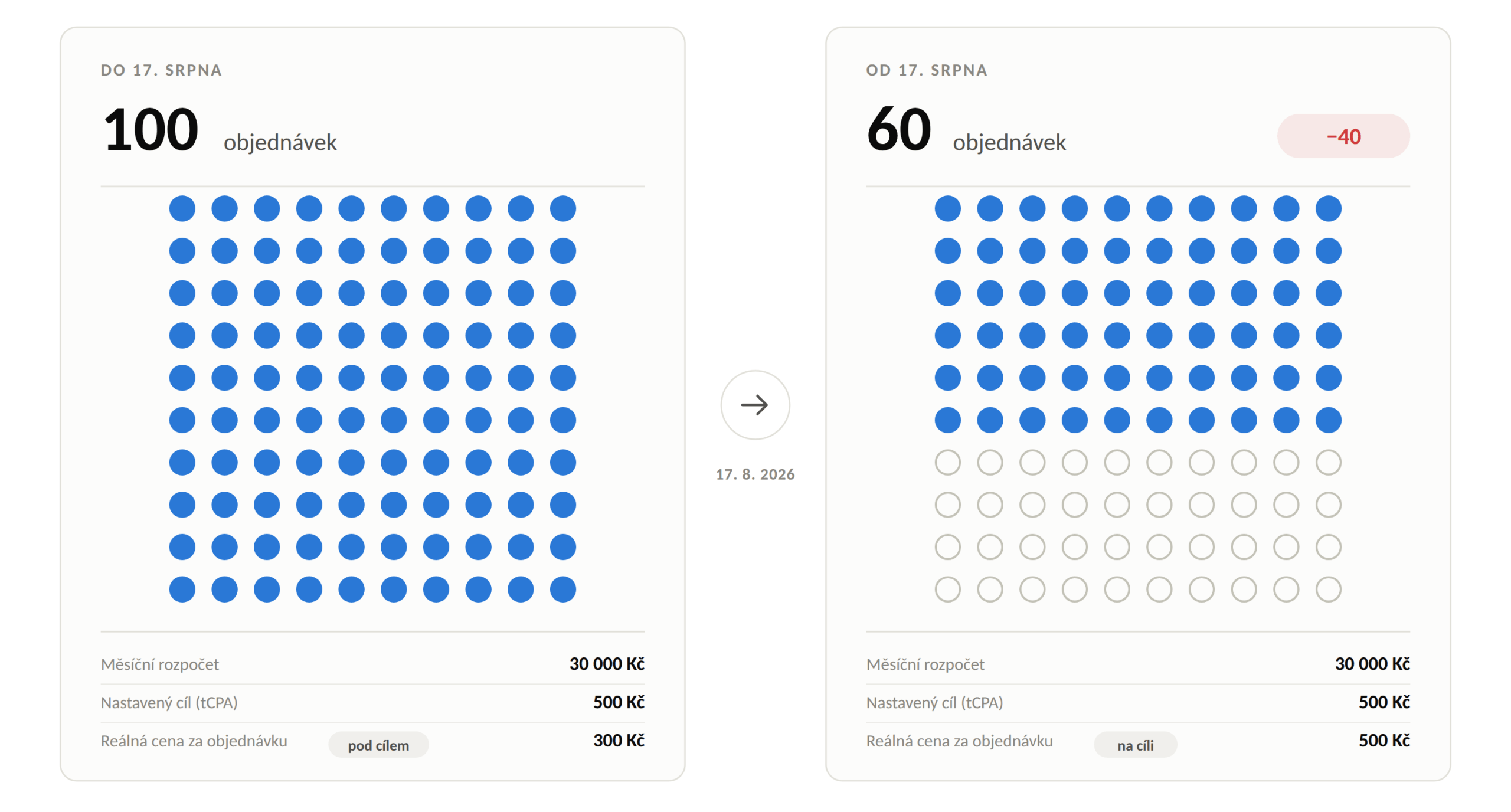
- monthly budget: 30,000 CZK
- Target CPA set: 500 Kč
- Actual CPA: 300 Kč
- number of conversions: 100
From an advertiser’s perspective, this situation is very favourable. He set a maximum target of 500 Kč, but the system managed to deliver conversions for an average of 300 Kč during that period.
What is Target CPA?

Target CPA (Cost per Acquisition) is a strategy whereby an advertiser sets a target average cost per conversion. For example, if they set the Target CPA to 500 Kč, they are telling Google: ‘I want to acquire conversions at an average cost of around 500 Kč.’ This does not mean that every single conversion must cost exactly 500 Kč. Some may cost, for example, 200 Kč, whilst others may cost 700 Kč. The system aims to achieve the set value on average.
From 17 August, Google is changing this behaviour for campaigns with a limited budget so that the system works more consistently towards the set target. This is an important difference. If the Target CPA is 500 Kč, we should no longer expect the campaign to utilise the budget cap in the long term by systematically acquiring conversions at a significantly lower cost. The set target carries greater weight in the automation process.
This change does not mean that Google will automatically increase your spend. If a campaign has a monthly budget of 30,000 Kč, it will continue to operate on a budget of 30,000 Kč following the change. The difference may lie in the cost per conversion. If the campaign has so far been generating orders at an average cost of 300 Kč, a budget of 30,000 Kč will allow it to generate approximately 100 orders.
If the average price moves towards the set Target CPA of 500 Kč, we will only reach 60 orders. The expenditure is the same in both cases. The only difference lies in how effectively the budget is utilised. This means 40 per cent fewer orders for the same budget. Of course, this is not a prediction that every campaign’s CPA will change in exactly this way. It is an illustration of the mechanism that needs to be understood when evaluating such changes.
Why setting a target may be more important than ever before
If a company sets its Target CPA at 500 Kč because it is willing to pay a maximum of 500 Kč per order, it may be tempting to set this figure as a sort of safety margin. For example, the actual desired CPA might be 350 Kč, but the Target CPA is set at 500 Kč.
Previously, such a reserve might have worked relatively well, as the system could still deliver cheaper conversions even with a target of 500 Kč. Following the change, we need to consider whether 500 Kč is really the value we want the system to aim for.
If a company sets its target too high, this may not merely give it greater scope for an automated strategy. In a campaign with a limited budget, this may simultaneously signal to the system that it is acceptable to pursue more expensive opportunities. Conversely, a target that is too low may significantly restrict the system and deprive it of auctions that would still be economically viable for the company.
Therefore, the aim is not to set the target as low or as high as possible. The aim is to set it so that it reflects the campaign’s actual performance.
 The most important thing is to distinguish the actual business goal from the value we have historically used as a safety margin. For example, if a company has long been acquiring orders for 300 CZK, but in Google Ads its Target CPA is set to 500 CZK just because it is the maximum acceptable value, we need to consider whether we really want to guide the system toward 500 CZK. After this change, the difference between actual performance and the set target can become significantly more important.

The campaign types affected include Search, Shopping, Performance Max, Demand Gen, Display, Hotel and Travel. The change does not, however, apply to App campaigns, Video Reach and Video View campaigns. This is therefore not a blanket change affecting all campaigns in Google Ads. The decisive factors are the combination of campaign type, the strategy used and whether the campaign is budget-constrained.
Google will not automatically overwrite your account settings
It is important for advertisers to note that, according to its documentation, Google does not automatically change the set target or budget.
So, for example, if a campaign has a daily budget of 1,000 Kč and a target CPA of 500 Kč, these values will remain the same after 17 August. The only thing that will change is the way the system uses these values during optimisation.
Google has also developed the Bid Target Adjustment Tool, which is designed to help you decide whether it is appropriate to adjust your current bid targets.
The tool offers four basic options:
- maintain the current target,
- adjust the target to reflect actual performance over the last few weeks,
- enter your own target value,
- switch to a different bidding strategy.
However, this does not mean that the tool will automatically find the ideal value for every account. The correct setting depends on the economics of the specific campaign and on the value that each conversion brings to the business.
The most important change may take place outside your account
There is one further aspect that is easy to overlook when assessing the change. Google Ads operates via auctions. This means that the ultimate performance of a single campaign also depends on how other advertisers behave. If, as a result of a change, more advertisers start optimising more aggressively towards their target values, they may be willing to enter a greater number of auctions or bid higher amounts in certain auctions.
This may increase competitive pressure. The result may not merely be a change in the performance of a specific campaign; the price of the auctions themselves within that segment may also change. This is a fundamental difference from standard account optimisation. Setting your own Target CPA or Target ROAS may influence the behaviour of a particular system, but it cannot isolate the advertiser from what their competitors are doing at the same time.
If, for example, ten competitors start to bid more aggressively in auctions, the price may rise for all participants.
What advertisers should keep an eye on following the change
The first reaction should not be to immediately reconfigure all targets. It is more important to first identify the campaigns that may be significantly affected by the change. Particular attention should be paid to campaigns that are regularly constrained by their budget and, at the same time, have an actual CPA significantly lower than the Target CPA, or an actual ROAS significantly higher than the set Target ROAS.
It is precisely in these areas that the gap between their current performance and their new target is greatest.
Following the change, it is advisable to monitor at least the following:
- a qualified CPA,
- number of conversions,
- conversion value,
- ROAS,
- percentage of the budget utilised,
- changes in visitor numbers,
- changes to the auction environment,
- and, above all, the economic value of the customers acquired.
For an online shop, for example, it is not only the number of orders that matters, but also the profit margin on them. With lead generation campaigns, on the other hand, not every lead is of equal value. If automation is optimised solely for the number of conversions, the resulting CPA may be excellent, but the business outcome may be poor.
This is precisely why the quality of the conversion data Google receives is becoming increasingly important in an automated bidding system.
After the change, we shouldn't just monitor whether Google is meeting the set CPA or ROAS. If we have the same budget but get fewer quality orders or leads in return, meeting the target by itself tells us nothing. It is important to compare campaign performance with the real value that conversions bring to the business, and adjust goals and budgets accordingly.
A change that highlights the importance of using automation correctly
Google Ads is gradually moving away from a system in which advertisers manually managed individual bids, towards one in which they primarily define their objectives and provide data to the algorithm. 17 August further reinforces this trend.
Advertisers today do not necessarily need to know how much to bid for a specific user in a specific auction. However, they must have a very clear understanding of the outcome they expect from the advert and the value that this outcome holds for them. This is precisely why the change introduced on 17 August is not merely a matter of a single new setting in Google Ads. For campaigns with limited budgets, it may affect the relationship between the objective, the budget, the number of conversions achieved and their cost.
And if the behaviour of a larger number of advertisers changes at the same time, this change may also be reflected in the auctions themselves. It therefore makes sense for businesses to simply let their campaigns run as normal after the change and monitor whether they are ‘meeting their targets’, whilst comparing previous and current performance on the same budget. Only from this comparison can it be determined whether the change has actually had an impact on a specific account and whether the current targets still align with business needs.
Summary of changes to Google Ads targeting strategies
| Question | Answer |
|---|---|
| When did the change begin? | 17 August 2026 |
| What is this about? | Campaigns with limited budgets and selected targeting strategies |
| What strategies? | Target CPA, Target ROAS, Target CPC for Demand Gen |
| What sort of campaigns? | Search, Shopping, Performance Max, Demand Gen, Display, Hotels, Travel |
| Will Google increase the budget automatically? | No |
| Does Google automatically adjust the Target CPA/ROAS? | No |
| What’s changing? | Campaigns with a limited budget should be directed more consistently towards the set objective |
| What might be the consequence? | With the same budget, fewer conversions may be achieved |
| Does the change apply to all campaigns? | No |
| What needs to be checked? | Budget status, actual performance, set targets and the economic value of conversions |
| Is it possible to say in advance that every account will reduce performance? | No. The impact depends on the specific settings and behaviour of the auctions |
Need to optimize your performance campaigns?
Related articles
 Advices and tips
Search advertising has long been based on the principle whereby a user enters a query and the advertising system attempts to find offers that...
 Content
Many products and services are based primarily on rational decision-making. Customers do not choose them on impulse, but based on price, specifications,...
Content
Czech Travel Agency, the operator of the Lázně Travel portal, is one of the leading players in the Czech market for spa and wellness breaks....