How we at Czech Travel Agency are helping to automate reporting using genAI
Czech Travel Agency, the operator of the Lázně Travel portal, is one of the leading players in the Czech market for spa and wellness breaks. Its portfolio includes nearly 500 hotels and thousands of holiday packages across seven countries; it processes tens of thousands of bookings every year, and its entire operation is supported by its own booking system, CRM, extensive integrations and an in-house customer service call centre.
Such a volume of data generates a vast amount of information that needs to be processed and analysed. In the tourism sector, however, the situation changes practically every day. Demand, seasonality, the performance of marketing channels, and the profit margins of individual hotels and product packages are all subject to change. Marketing and business decisions must therefore be based on up-to-date data, which can be viewed from hundreds of different angles. That is precisely why we worked together to find a way to move reporting away from static dashboards towards an environment where you can query the data using natural language.
The four main limitations of traditional reporting
Czech Travel Agency had been working with a robust database for some time. It utilised Google Analytics, advertising platforms, its own CRM, a booking system, data from its telephone support service and Microsoft Power BI. We were also involved in developing some of the reports. At the same time, we helped the company to store, share and manage data more effectively across the organisation. However, as the company grew, the limitations of traditional reporting became increasingly apparent.
The first challenge was speed. The company operates in a highly dynamic environment where it is necessary to respond almost immediately. If a new question arises, there is no time to wait for another dashboard to be created or for an existing report to be amended.
The second problem was the diversity of users. A CEO needs to monitor completely different metrics to those tracked by the marketing team, sales staff, the finance director or content specialists. A single, one-size-fits-all dashboard no longer made sense.
Another challenge was the company’s growth itself. New roles, new processes and new requirements for digitalisation were emerging. With every change, the need to create further data insights also grew.
And finally, there was the issue of mobility. Many people need to access information whilst away from the office. They don’t want to have to open several systems and search for the right report. They simply need to ask a question and get an immediate answer.
From dashboards to data-driven discussions
Instead of adding another layer of reports, we proposed a different approach. The aim was not to create a new dashboard, but to enable employees to interact with company data as naturally as they currently interact with generative AI. We therefore designed an architecture built on the Claude platform, which is capable of responding to queries on the company’s internal data via a unified query console.
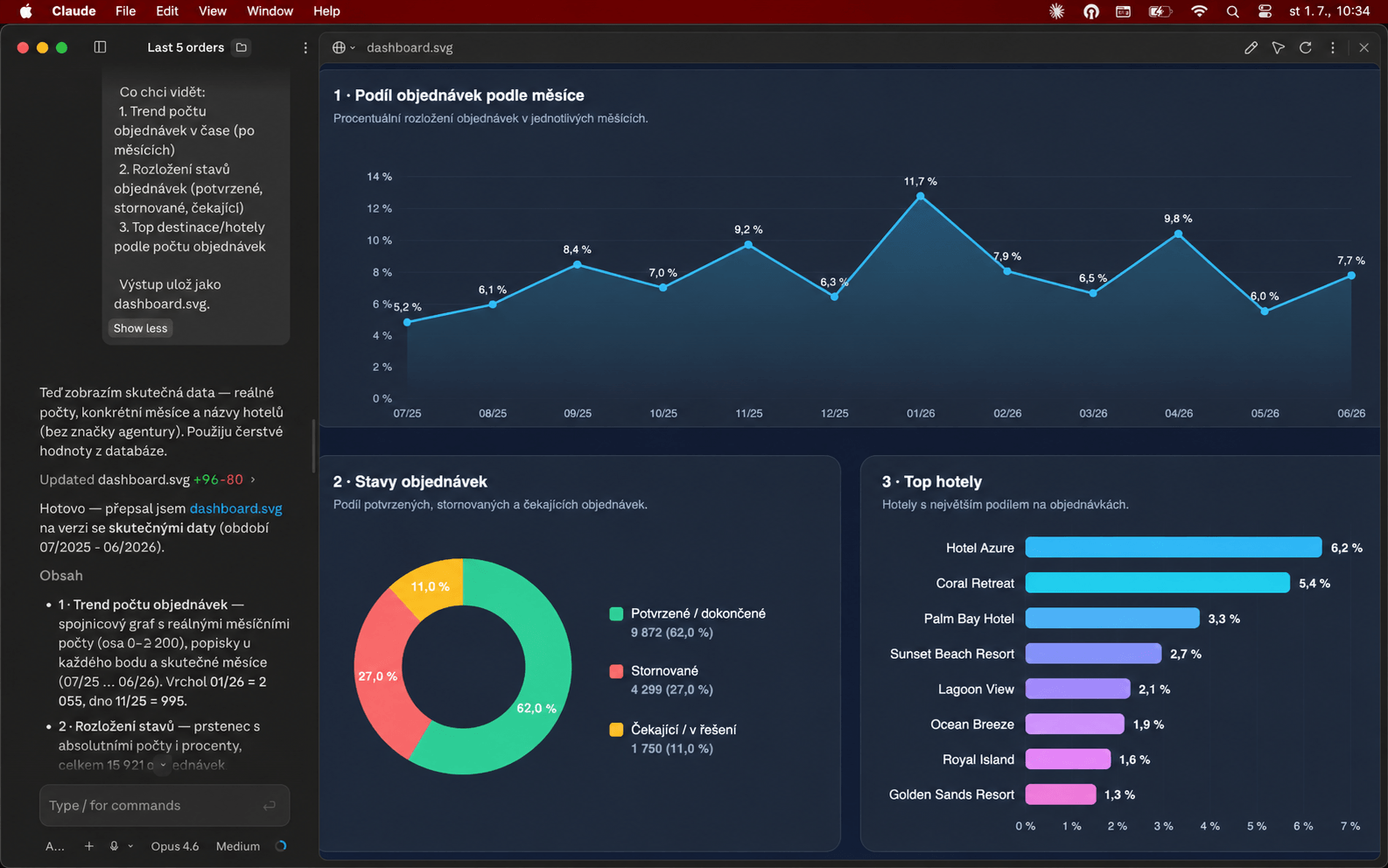
Users no longer need to think about where specific information is located or which report to open. All they have to do is ask.
For example:
- How are holiday stays in the Jeseníky Mountains faring this week compared to last year?
- Which hotels consistently have the highest profit margins?
- What proportion of bookings were made via the telephone helpline?
- Which campaigns bring in customers with the highest order value?
Key challenges of the project
In projects of this kind, the greatest attention is usually paid to the language model itself. In reality, however, it represents only the final layer of the entire solution. The most important part of our work took place much further down the line.
Firstly, we needed to stabilise the database and consolidate information from a wide range of different systems. We then built an MCP server on top of these, which acts as a unified layer between the company’s data and the language model. This layer determines whether the AI responds correctly, quickly and consistently. It is not enough simply to make the database accessible; the data must be prepared in such a way that the model can search for it effectively, interpret it correctly and work only with the information it actually needs.
One of the biggest challenges facing such systems is their operational cost. Every query consumes tokens, and with large corporate databases, costs can rise very quickly. Response speed is equally important. A large part of the design therefore focused on optimising the entire architecture. We designed the individual layers so that the model receives only relevant data, minimises the amount of information processed and, at the same time, provides responses in the shortest possible time.
From hours to minutes – data available instantly and to everyone
Instead of searching for the right dashboard or submitting a request to create a new report, employees can work with the data immediately and independently. Previously, gaining a new perspective on the data often involved preparing or modifying a report in Power BI. Today, in most cases, all it takes is to formulate the right query in natural language and, within moments, receive an answer complete with the necessary context. To give you an idea, creating a new, bespoke view of the data used to take several hours. With the new system, genAI can generate a view of any complexity in just a few minutes.
 We are a market leader in spa stays thanks to our client service, which increasingly relies on data-driven insights. Together with TRITON IT, we are transforming how we access information; instead of navigating through dashboards, we simply ask questions using natural language. Company-wide decision-making has been reduced from days or hours to mere minutes, helping us further enhance our services.

Technology doesn’t work without people. Training was the key
The project involved more than just technical implementation; we also trained Czech Travel Agency staff on how to work with the new system and how to formulate queries correctly. Generative AI does not replace the ability to interpret data, but it does significantly shorten the path to obtaining it.
Summary
We have changed the way people access data. Instead of searching for the right report, they can start with a question. And that is precisely what significantly speeds up day-to-day decision-making across the entire company.
Do you need help with reporting?
Related articles
 About us
How is artificial intelligence used in video production? What are MCP servers and how do they help developers? And what if you could control...
 Content
ACOND is one of the leading Czech manufacturers of heat pumps and has been operating on the market since 1998. The development, testing and...
 Advices and tips
Search advertising has long been based on the principle whereby a user enters a query and the advertising system attempts to find offers that...